♞Chess2Story
PlayersGamesPricingFeaturesLab
+ New Game
PlayersGamesPricingFeaturesLab
Est. 2026The Colophon

Chess, told as a story.

Every game becomes a comic book, a chivalric tale, or a grandmaster's review — three renderings of the same moves, handcrafted page by page.

◆

✦ Worlds

  • The War of the Three Kingdoms
  • Arcanum Academy
  • The Saga of King Arthur
  • The World of Cossack
  • The Great War of Kurukshetra
  • Malibu vs Venice: Two Coasts of LA
  • All worlds →

✦ Recent stories

  1. I.
    The Road from Vermilion Walls
    Wei, Yi vs Bruzon Batista, Lazaro
  2. II.
    The Road from Vermilion Walls
    Wei, Yi vs Bruzon Batista, Lazaro
  3. III.
    The Silence of Kawanakajima
    Short, Nigel vs Timman, Jan
  4. IV.
    The Wedge of Autumn
    Short, Nigel vs Timman, Jan
  5. V.
    Salt Fog at the Gate
    Capablanca, José Raúl vs Marshall, Frank
  6. VI.
    The Gate That Stayed Open
    Steinitz, Wilhelm vs Von Bardeleben, Curt
  7. Browse all →

✦ Find

  • Home
  • Pricing
  • The Collection
  • The catalogue
  • Players
  • Comics
  • The Lab
  • About
  • Contact

Fine print

  • Privacy
  • Terms
  • Cookies
Chess2Story
A narrative engine for chess
Handset in Fraunces · Printed from the cloud
© 2026 Chess2Story. All moves reserved.
Immortal Games · Famous games✓ VERIFIED SCORE

The Evergreen Game

A quiet rook move hides a queen sacrifice, a double check, and a two-bishop mate — Anderssen's second masterpiece, and maybe his deeper one.

Anderssen, Adolf against Dufresne, Jean  ·  Casual game · 1852  ·  1–0

COMIC 1 worldSTORY 1 tellingMOMENTS 4 turnsSCORE verified PGN
Turn your own game into a comic →
What happened

The story behind it

A year after the Immortal Game, Adolf Anderssen sat down in Berlin for a casual game with Jean Dufresne — his own student, a capable master and a prolific chess writer. It was the Evans Gambit, the signature opening of the age: White gives a wing pawn at move four to seize the center and aim both bishops at the black king.

Dufresne defended actively, and by move eighteen had real threats of his own — his queen and rook bearing down the g-file at the white king. What followed is the most analyzed pair of moves of the nineteenth century. Anderssen played 19.Rad1, a rook to a quiet file, seemingly oblivious to the storm. Generations of annotators, Lasker and Neishtadt among them, have disputed whether it was the strongest move or merely the most beautiful; what is not disputed is what it prepared.

Two moves later the white queen landed on d7, where two black pieces could take her. The king had to. And the bishop check that followed was a double check — rook and bishop at once — the one kind of check no interposition and no capture can answer. The king walked, the second bishop came down, and Dufresne was mated holding an extra queen and rook.

Steinitz, the first World Champion and no sentimentalist about the Romantic school he had dismantled, called the game the evergreen in Anderssen's laurel wreath. The name stuck because it is accurate: a century and a half of engines and revisionists have pruned at the analysis, and the game is still green.

Black threatens mate — and White replies with the quietest move on the board.

No date, no venue, no stake was ever recorded. Two men sat down in Berlin in 1852, and only the moves survive.

The turns of the screw

The moments

Click one — the board above jumps there.

Get this breakdown for your game →
The cast

The players

Adolf Anderssen

Adolf Anderssen

1818 — 1879 · BRESLAU

The winner of London 1851 and the strongest player of the Romantic age. The Immortal Game shows his daring; the Evergreen shows his depth — a combination prepared by the quietest move on the board.
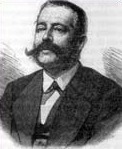
Jean Dufresne

Jean Dufresne

1829 — 1893 · BERLIN

Anderssen's pupil, a novelist under an anagram pen-name, and the author of the most-read German chess primer of the century. He spent a career teaching others openings — and entered history on the losing side of his teacher's masterpiece.

Machine-checked

The score

The moves are history's; we checked them against it.

1. e4 e5 2. Nf3 Nc6 3. Bc4 Bc5 4. b4 Bxb4 5. c3 Ba5 6. d4 exd4 7. O-O d3 8. Qb3 Qf6 9. e5 Qg6 10. Re1 Nge7 11. Ba3 b5 12. Qxb5 Rb8 13. Qa4 Bb6 14. Nbd2 Bb7 15. Ne4 Qf5 16. Bxd3 Qh5 17. Nf6+ gxf6 18. exf6 Rg8 19. Rad1 Qxf3 20. Rxe7+ Nxe7 21. Qxd7+ Kxd7 22. Bf5+ Ke8 23. Bd7+ Kf8 24. Bxe7# 1-0 1–0

ECO C52 · our PGN header reads Date 1852.??.?? — the year is certain, the day is not, and we would rather be honest than traditional.

↓ DOWNLOAD PGN
Your game could look like this.Make mine

Provenance

First printed in the Deutsche Schachzeitung in the autumn of 1852; the score replays legally by machine to the mating position. The exact date and setting were never recorded — a casual game, presumably in Berlin. Verified 2026-08-04.
  • Deutsche Schachzeitung, 1852 — the first printing, September–October issues
  • Wikipedia, "Evergreen Game" — the standard score and its publication history
  • Machine replay — the score replays legally to the mating position, 47 plies
After the game

Where this goes next

Your game could be next.

Paste a PGN, pick a world, and read your own game the way you just read this one — drawn, narrated, printable.

Make this from my game
Keep going

More famous games

The catalogue of games that made chess history — each one a playable story.

Browse the collection →

Questions

What is the Evergreen Game?
A casual game played in Berlin in 1852 between Adolf Anderssen and his pupil Jean Dufresne. A year after the Immortal Game, Anderssen produced a second combination for the ages — a queen sacrifice on d7 that opens a double check and finishes in a mate by the two bishops.
Why is it called "evergreen"?
The name traces to Wilhelm Steinitz, the first World Champion, who called the game the evergreen in Anderssen's laurel wreath — the leaf that would never fade. Chess writers shortened it, and the shortened name became permanent.
What is the famous move?
19.Rad1 — a quiet rook move played with Black threatening mate. It looks almost absent-minded; it is in fact the deepest move of the century, preparing the queen sacrifice and the double check three moves before they land. Annotators have argued about its soundness for over 170 years without settling it.
Who was Dufresne?
Jean Dufresne was Anderssen's student and a Berlin chess author whose beginner's handbook taught generations of German players. Like Kieseritzky before him, he is remembered mainly for losing beautifully — and he, too, helped publish the game that beat him.