The Gold Coins Game
With his queen attacked, Marshall puts her on the one square where all three captures lose at once. Legend says gold rained on the board.
Levitsky, Stepan against Marshall, Frank · 18th DSB Congress, Masters Tournament · 1912.07.20 · 0-1
The story behind it
The 18th Congress of the German Chess Federation met in Breslau in the summer of 1912, in the middle of what chess historians call Rubinstein's year. But the game the congress is remembered for was played between two men having rougher tournaments: Stepan Levitsky, the Russian amateur champion, and Frank Marshall, the perennial American one.
Marshall's opening went sideways — his French Defence conceded the center early, and by move nineteen Levitsky stood clearly better, a pawn to the good with the black attack seemingly spent. Then Levitsky grabbed a second pawn instead of consolidating, and Marshall's pieces came alive: a knight to d4, rooks doubling, the white queen lured offside. On move 22 Marshall took a bishop with his rook, daring the g-pawn to recapture. Levitsky instead attacked the black queen, expecting a retreat.
He received 23...Qg3 — the queen advancing into a square attacked three ways. The f-pawn's capture allows a knight fork and mate; the h-pawn's capture allows a smothered mate by the knight on f3; the queen's capture allows the same fork on e2 to win everything back with interest. There is no fourth option and no defense. Levitsky, to his lasting credit, saw all of it at once and resigned immediately.
Marshall's memoirs record spectators showering the board with gold pieces; his wife remembered no such shower, and skeptics suggest the coins were gamblers settling bets. The argument has outlived everyone who was in the room, which is fitting — the move needs no ornament, and chess, which loves its legends almost as much as its moves, has voted to keep both.
The moments
Click one — the board above jumps there.
The players
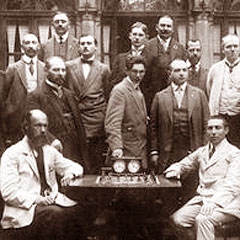
Stepan Levitsky
Russia's amateur champion of 1911 and a dangerous match player — Alekhine himself took him seriously enough to play him a match. He had winning chances in this game as late as move nineteen, and his name now lives on the wrong side of its final move.
in the archive
Frank Marshall
U.S. Champion for twenty-seven years, founder of the Marshall Chess Club, and the great swindler-showman of American chess. He kept a prepared attack in a drawer for eight years and a legend of gold coins in his memoirs — and one move of his is more famous than most players' careers.
The score
The moves are history's; we checked them against it.
ECO C10 · our PGN header reads Date 1912.07.20
↓ DOWNLOAD PGN