Rubinstein's Immortal
His queen is attacked — so he leaves her, and throws a rook, then the other rook, then a bishop onto squares where every one can be taken.
Rotlewi, Gersz against Rubinstein, Akiba · Lodz · 1907.12.26 · 0-1
The story behind it
Łódź in 1907 was a textile boomtown with one of the most concentrated chess communities in Europe, and the day after Christmas its two best players sat down against each other. Gersz Rotlewi was twenty-two, the city's rising star. Akiba Rubinstein, twenty-seven, was already among the strongest players in the world — a quiet, methodical man whose games usually won by accumulation, not explosion.
For twenty moves the game was a mirror: both sides fianchettoed, both queens stepped out, near-symmetry with White a tempo ahead. Rotlewi spent his tempo carelessly, opened the long diagonal at the wrong moment, and Rubinstein's pieces settled onto their squares like weather changing. Then Rotlewi played 22.g3, attacking the black queen, and received the most famous answer in Polish chess history: Rubinstein left the queen where she stood and played 22...Rxc3.
Take the queen, and mate follows on the long diagonal. Take the rook, and the other rook decides. Rotlewi took the queen; Rubinstein played 23...Rd2 — the second rook onto a defended square — then took on e4 with check, and finished with 25...Rh3: an unprotected rook placed gently beside the white king, threatening a mate that no capture, no block, and no counter-check could prevent. Rotlewi resigned with an extra queen on the board.
Hans Kmoch later gave the game its permanent name, borrowing the adjective from Anderssen's masterpiece; Kasparov, compiling his predecessors a lifetime later, called it Rubinstein's most famous creation. The man himself never reached his world title match — the First World War closed that window — but the day after Christmas 1907, the finest positional player of his era proved he could also attack like nobody alive.
The moments
Click one — the board above jumps there.
The players

Gersz Rotlewi
A brilliant young master from Łódź's extraordinary chess community — strong enough to finish ahead of Rubinstein at Hamburg 1910, gone from chess by twenty-two through illness. This game preserved his name the way amber preserves: perfectly, and not the way he'd have chosen.
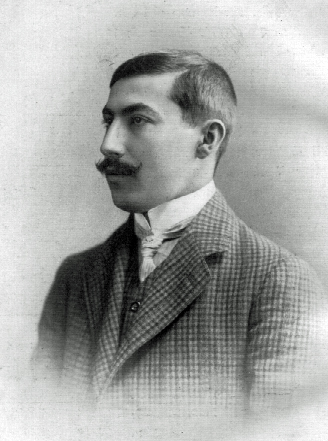
Akiba Rubinstein
The great positional artist of the pre-war era, a rabbinical student turned chess professional whose endgames are still the textbook. He was expected to challenge Lasker for the world title; the war took the chance. Here, once, the quiet man played the loudest combination of his age.
The score
The moves are history's; we checked them against it.
ECO D32 · our PGN header reads Date 1907.12.26
↓ DOWNLOAD PGN