The Evergreen Game
A quiet rook move hides a queen sacrifice, a double check, and a two-bishop mate — Anderssen's second masterpiece, and maybe his deeper one.
Anderssen, Adolf against Dufresne, Jean · Casual game · 1852 · 1–0
The story behind it
A year after the Immortal Game, Adolf Anderssen sat down in Berlin for a casual game with Jean Dufresne — his own student, a capable master and a prolific chess writer. It was the Evans Gambit, the signature opening of the age: White gives a wing pawn at move four to seize the center and aim both bishops at the black king.
Dufresne defended actively, and by move eighteen had real threats of his own — his queen and rook bearing down the g-file at the white king. What followed is the most analyzed pair of moves of the nineteenth century. Anderssen played 19.Rad1, a rook to a quiet file, seemingly oblivious to the storm. Generations of annotators, Lasker and Neishtadt among them, have disputed whether it was the strongest move or merely the most beautiful; what is not disputed is what it prepared.
Two moves later the white queen landed on d7, where two black pieces could take her. The king had to. And the bishop check that followed was a double check — rook and bishop at once — the one kind of check no interposition and no capture can answer. The king walked, the second bishop came down, and Dufresne was mated holding an extra queen and rook.
Steinitz, the first World Champion and no sentimentalist about the Romantic school he had dismantled, called the game the evergreen in Anderssen's laurel wreath. The name stuck because it is accurate: a century and a half of engines and revisionists have pruned at the analysis, and the game is still green.
The moments
Click one — the board above jumps there.
The players

Adolf Anderssen
The winner of London 1851 and the strongest player of the Romantic age. The Immortal Game shows his daring; the Evergreen shows his depth — a combination prepared by the quietest move on the board.
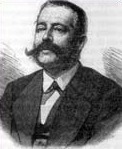
Jean Dufresne
Anderssen's pupil, a novelist under an anagram pen-name, and the author of the most-read German chess primer of the century. He spent a career teaching others openings — and entered history on the losing side of his teacher's masterpiece.
The score
The moves are history's; we checked them against it.
ECO C52 · our PGN header reads Date 1852.??.?? — the year is certain, the day is not, and we would rather be honest than traditional.
↓ DOWNLOAD PGN